Cooperative care for dogs can make grooming and routine handling easier by teaching your dog what to expect. Instead of simply holding your dog still, you build skills that allow your dog to participate. That approach can change how both of you experience necessary care.
Perhaps your dog disappears when the nail clippers come out or pulls away when you reach for a paw. Even brushing, checking an ear, or looking at a sore spot can become difficult. Cooperative care starts before that struggle begins.
What Is Cooperative Care for Dogs?
Cooperative care teaches a dog to participate voluntarily in necessary handling. Touch, equipment, positions, and procedures are introduced gradually while calm participation is reinforced. The goal is not to see how much your dog will tolerate.
That distinction is important. A frightened dog that freezes while being restrained may look cooperative but still feel overwhelmed. Real progress means watching your dog’s response while gradually building a new skill.
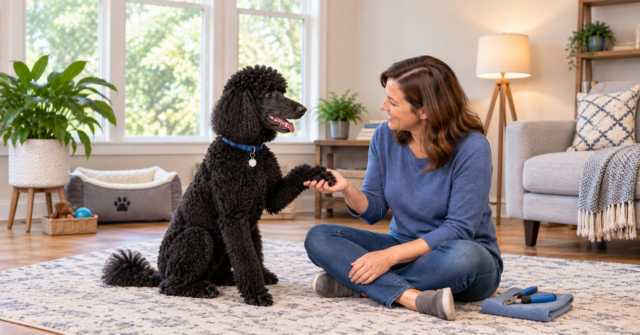
Training might begin with a brief touch to the shoulder followed by a reward. Later, you may work toward holding a paw, examining an ear, brushing teeth, or trimming a nail. There is no reason to complete the entire task during one session.
The Cornell Riney Canine Health Center recommends gradual exposure, positive reinforcement, and attention to canine body language. It also emphasizes keeping practice below the dog’s stress threshold.
Small Successes Add Up
Imagine that your dog is frightened by nail clippers. It is easy to measure success by whether you managed to trim a nail. However, that may be far beyond today’s lesson.
Success might mean your dog notices the clippers on a nearby table and remains relaxed. Tomorrow, the clippers might move a little closer. Eventually, your dog may comfortably investigate them before you ever touch a paw.
These steps can seem almost too small to count. However, they let you build on calm experiences instead of repeatedly recovering from frightening ones.
Learn What Your Dog Is Telling You
Dogs often show discomfort long before they growl, snap, or struggle. Looking away, lip licking, pulling back, freezing, or trying to leave can signal difficulty. Learning those early signs gives you a chance to respond before fear escalates.
You might also notice tense muscles, ears held back, trembling, panting, or hesitation when grooming equipment appears. No single signal tells the entire story. Watch your dog’s overall behavior and the situation around it.
Walking away does not automatically mean stubbornness. Your dog may be telling you that you have moved ahead too quickly. An easier next attempt can accomplish more than immediately repeating the difficult one.
Create a Predictable Starting Place
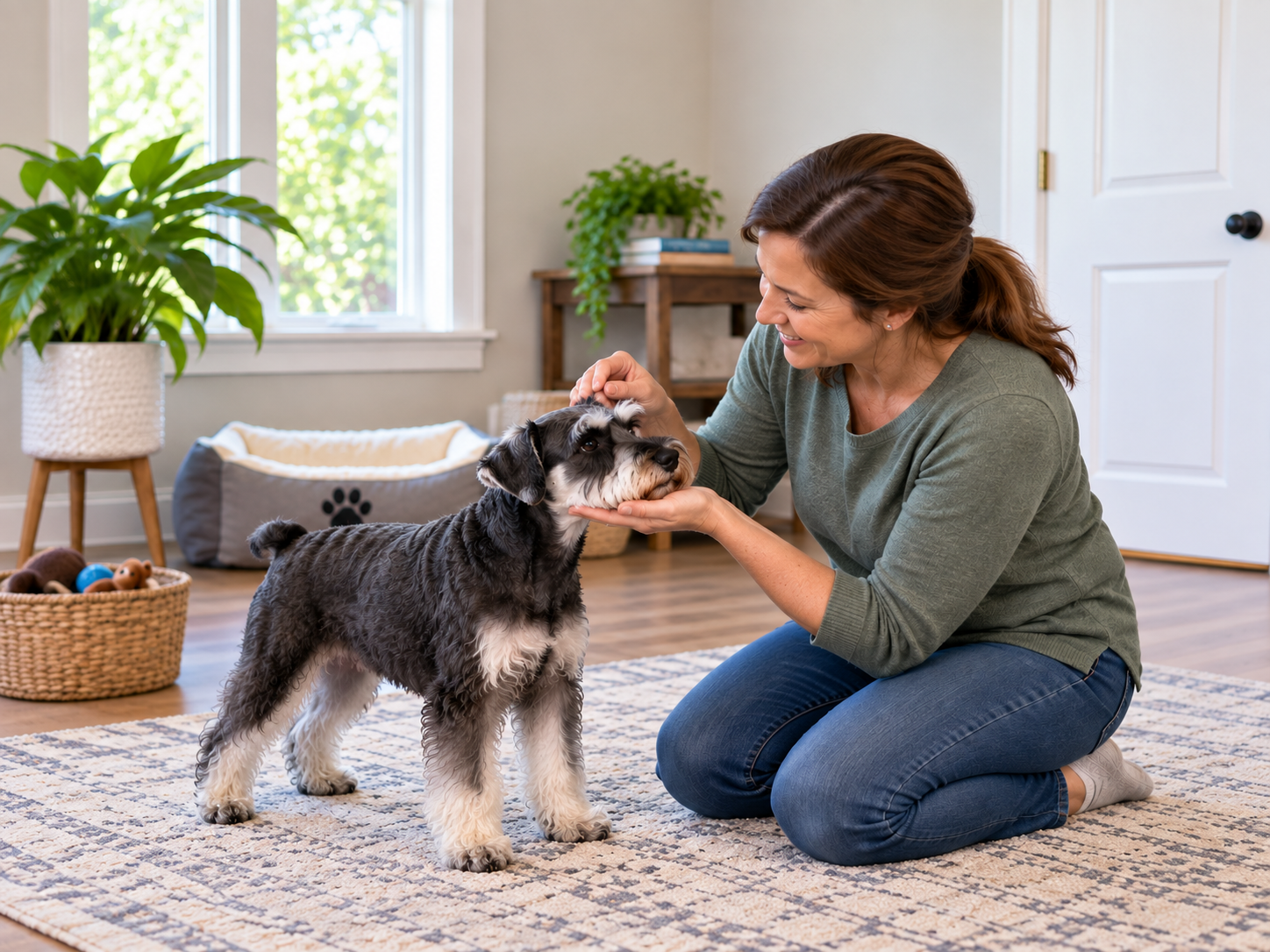
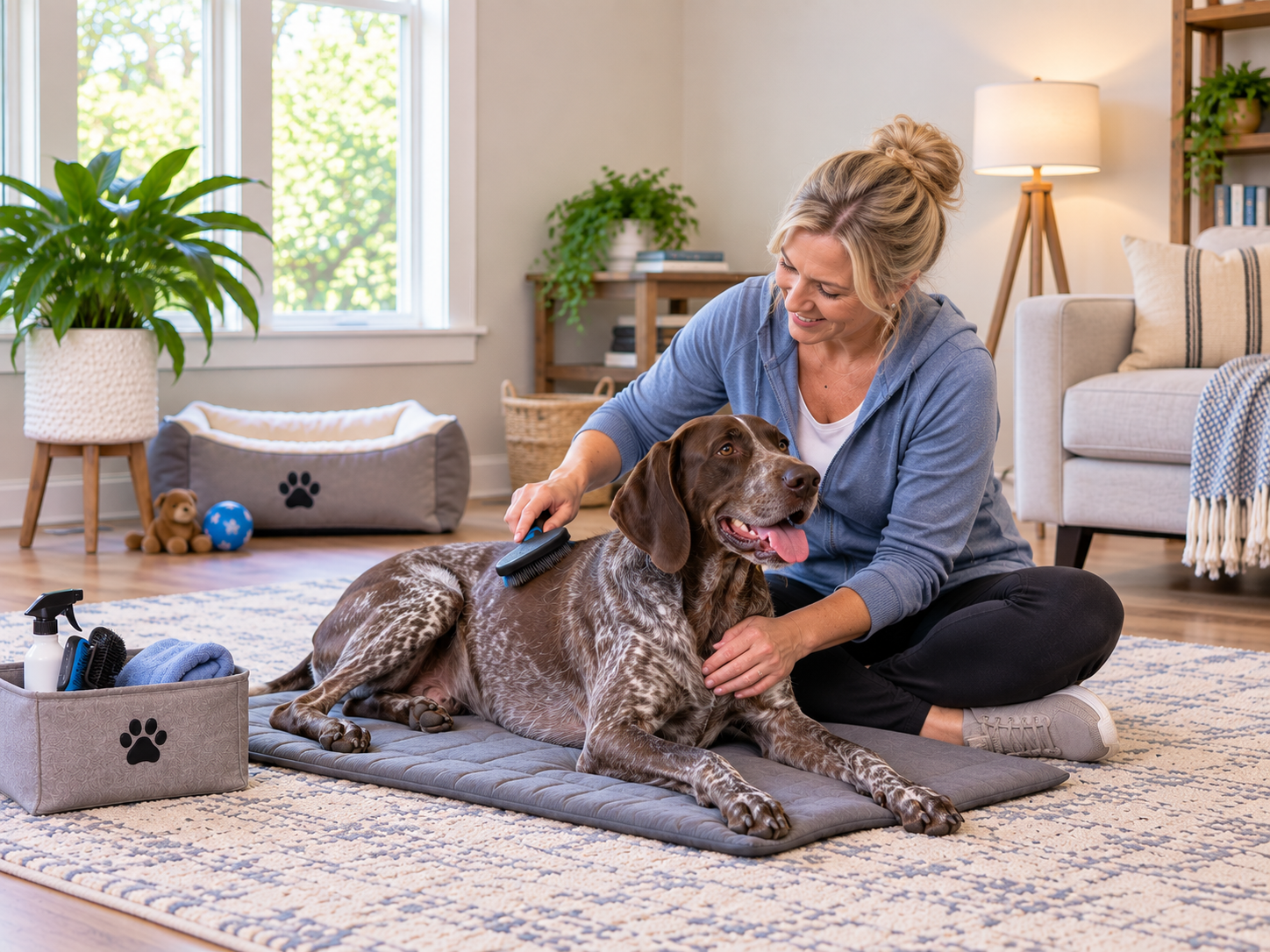
Routine can make cooperative care easier to understand. A non-slip mat, dog bed, grooming surface, or another familiar station gives the interaction a clear beginning. Secure footing can also help a dog feel steadier during handling.
First, make the station a pleasant place without adding grooming. Reward your dog for standing, sitting, or settling down there. Once that foundation is familiar, introduce a very small part of the care routine.
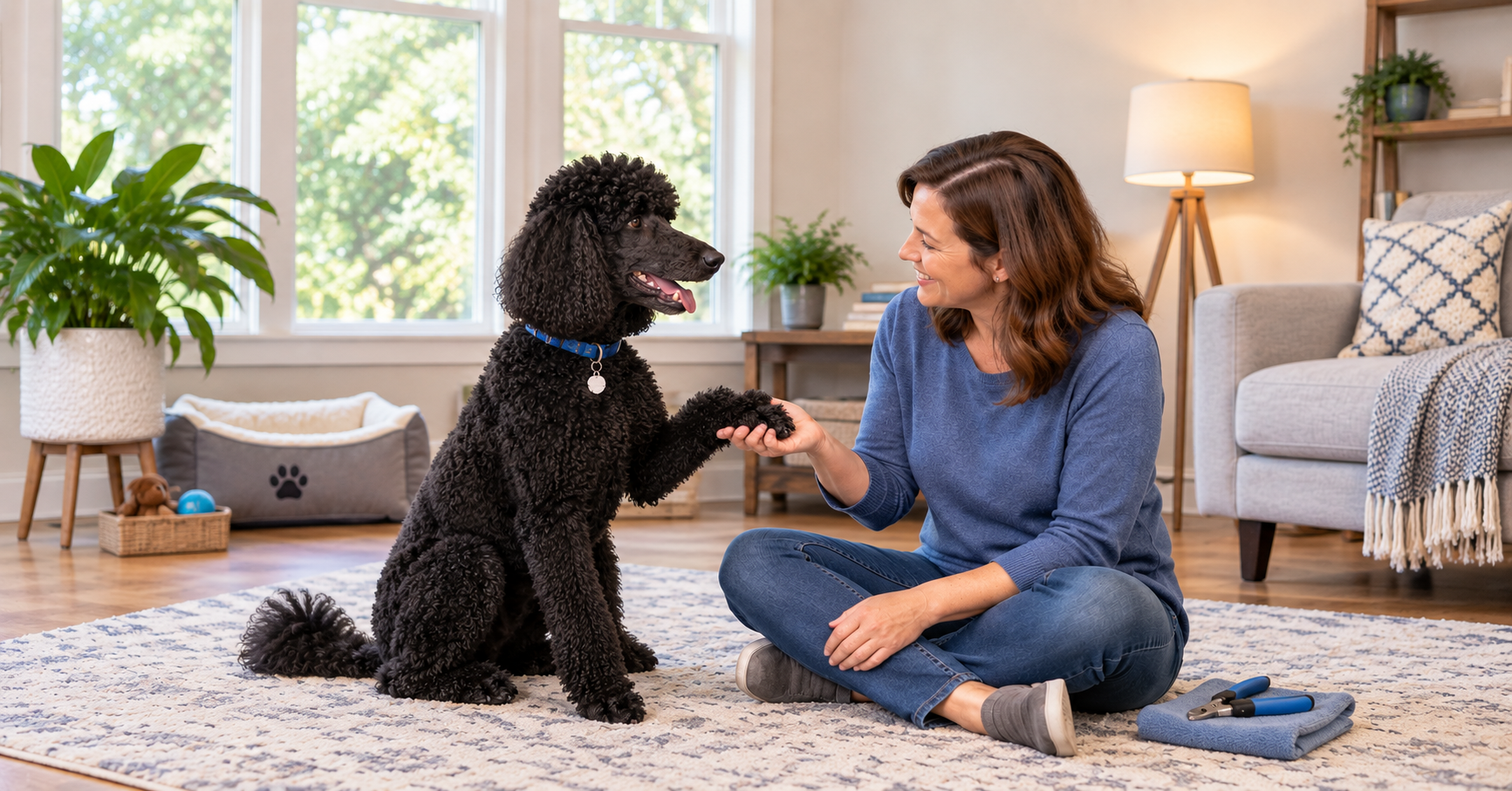
Dogs can also learn a chin rest. The dog places their chin on your hand, lap, towel, or another designated surface while you reinforce the position. Successful cooperative care does not depend on teaching one particular exercise.
Break Handling Into Tiny Steps
Suppose the eventual goal is trimming your dog’s nails. Reaching down, taking a paw, and clipping a nail combines several challenges at once. Breaking the process apart gives your dog a chance to learn each piece.
Start where your dog is already relaxed. Briefly touch the shoulder and reward that response. As this becomes routine, move farther down the leg before progressing to the paw and individual toes.
Holding the paw becomes another step. Slowly, desensitize your dog to being touched down the leg and to compfortably allow you to hold his paw and each toe. Examining a nail comes later. Only then does actually trimming the nail enter the process.
Your dog’s response determines when to advance. If tension or avoidance appears, return to an easier stage rather than trying to push through it. VCA Animal Hospitals recommends this small-step approach for nail-care training.
Let Grooming Tools Become Ordinary
Sometimes the touch itself is not the biggest problem. A dog can learn that clippers, grinders, brushes, toothbrushes, or ear-care supplies predict an unpleasant experience. Seeing the equipment may then trigger concern before you begin.
Change that prediction before using the equipment. Let the tool appear at a distance your dog can manage, pair its presence with something enjoyable, and then put it away. Nothing else has to happen.
A nail grinder adds sound and vibration, so those features need their own introduction. Your dog might first see the switched-off grinder, then hear it running from farther away. Bringing it closer or touching it to a nail comes only after the earlier stages become routine.
Use Rewards Without Rushing
Food is often useful because small rewards can be delivered quickly. Choose something your dog genuinely values and keep sessions short enough to avoid frustration. Your dog should not have to endure intense fear to earn the reward.
Rewards help build a better association while the exercise remains manageable. This is where desensitization and counterconditioning can work together. Both approaches depend on keeping the experience at a level the dog can handle.
Desensitization introduces a concerning experience at a low intensity. Counterconditioning pairs that experience with something positive. Progress may be quick for one dog and much slower after frightening experiences.
Do Not Wait for a Growl
One of the most important cooperative-care skills belongs to you. Learning when to stop can prevent a manageable concern from becoming a battle. Early signals deserve attention even when your dog has not tried to escape.
A dog may still eat treats while growing increasingly tense. Look beyond the food and notice freezing, pulling away, avoiding the station, trembling, or attempts to escape. Growling and snapping are much later warnings.
Stopping does not mean the dog has “won.” It means you received information about the difficulty of the exercise. Use that information to make the next session more achievable.
Practice When Nothing Has to Be Finished
Training becomes much harder when all the nails must be trimmed today. The need to finish can tempt anyone to move faster than the dog is ready to go. Rushing is one of several dog training mistakes that can make learning harder.
Instead, practice when there is no deadline. Touch a paw, reward the response, and move on with your day. Bring out the brush, create one pleasant interaction, and put it away again.
Those brief encounters build a history in which every touch does not lead to a long grooming session. Puppies can learn these habits before problems develop, but adult dogs can learn new responses as well. Age does not prevent you from starting with manageable steps.
Once your dog participates comfortably, knowing how to groom your dog at home safely can help you choose appropriate tasks. Some grooming needs are better left to an experienced professional.
Take Cooperative Care Beyond Grooming
The same foundation can help when you need to examine ears, teeth, paws, skin, or another body area. Familiarity with gentle handling can also prepare a dog for some parts of veterinary care. These skills become especially useful before a problem develops.
A clinic brings additional challenges, including unfamiliar people, equipment, smells, and surroundings. Your dog may someday need injections, blood collection, medication, bandages, or other procedures. Cooperative-care training cannot make every medical experience predictable.
You can still prepare useful skills. Ask your veterinary team which behaviors could help your particular dog, especially if previous visits have been difficult. Some clinics may offer low-pressure visits that help worried dogs become familiar with the environment.
What If Your Dog Already Hates Grooming?
Previous experience changes where training should begin. A dog frightened by nail clippers may need to start with the clippers across the room. Starting at the dog’s current comfort level gives you something workable to build upon.
Likewise, a dog that avoids paw contact may initially practice only shoulder or leg touches. Begin with something your dog can manage instead of starting where you wish the dog could be. Increase the difficulty only after the easier step becomes routine.
Repeatedly exposing a frightened dog to an intense experience does not guarantee the dog will eventually “get used to it.” Continuing while distress increases can make the response stronger. Progress may take days, weeks, or longer depending on the dog and its history.
When Training Is Not the Whole Answer
Not every handling problem begins with fear or insufficient training. Pain can make a normally tolerant dog suddenly resist being touched, brushed, moved, or examined. Persistent paw licking can also signal that something besides training needs attention.
A sudden change deserves veterinary attention, particularly when you notice other signs of discomfort or illness. Addressing a medical cause comes before treating the response as a training problem. Training should not be used to push a dog through suspected pain.
Severe fear or aggressive behavior may also require professional help. A veterinarian, veterinary behaviorist, or qualified trainer experienced with humane behavior modification can help determine a safer approach. Some dogs may need medication or sedation for particular grooming or veterinary procedures.
Necessary Care Cannot Always Wait
Cooperative care works best when skills are developed before they become urgently necessary. Unfortunately, an injured paw, infection, broken nail, or another medical problem may need immediate attention. Your dog’s medical needs take priority in an urgent situation.
Your veterinary team can decide how to complete necessary procedures while reducing stress and risk as much as practical. Medication, restraint, or sedation may sometimes be appropriate. Using those options when needed does not mean cooperative-care training has failed.
Once the immediate problem has been addressed, training can resume at an appropriate level. What you teach afterward may make the next necessary procedure considerably easier. Even small improvements can make future care more manageable.
Build Cooperation One Step at a Time
Your dog does not need to love every brush, examination, or nail trim. A more realistic goal is a dog who understands the routine and has learned useful ways to participate. That can make ordinary care less difficult for everyone involved.
Progress may begin with only a few relaxed seconds beside the nail clippers. Eventually, those seconds may become a calmly held paw, an ear you can examine, or a grooming session that no longer starts with hiding.
Cooperative care for dogs grows from those small successes. By noticing your dog’s responses and adjusting the pace, you can make many necessary routines easier for both of you.
Amazon Affiliate Disclosure: As an Amazon Associate, Excellent Dogs Club may earn from qualifying purchases. This does not change the price you pay.
Photo Credit: All images © Sloan Digital Publishing and licensed stock sources. Used with permission.