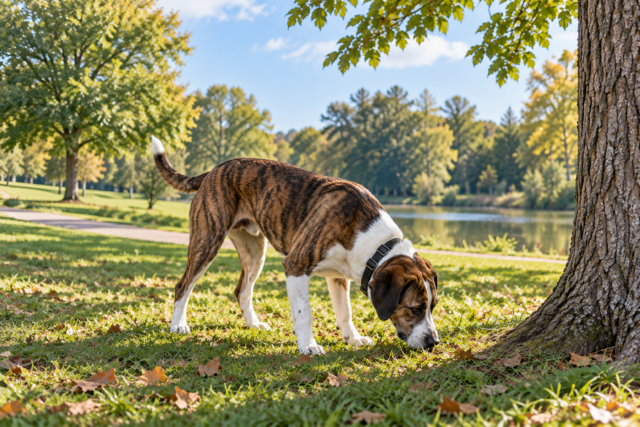
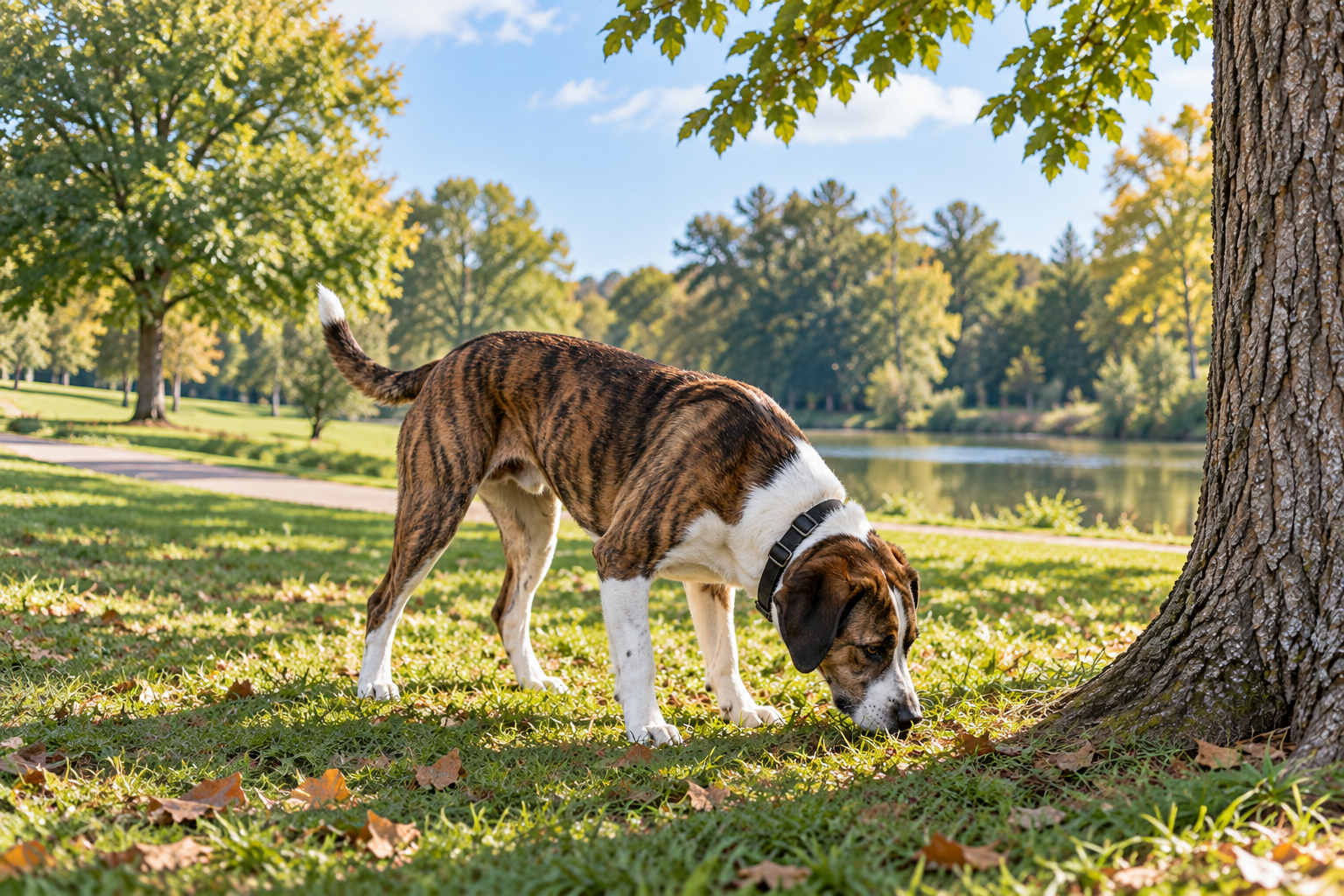
Dog pheromones and other scent signals help dogs gather information about the animals and environment around them. Your dog may stop at a patch of grass, sniff with intense concentration, move a few feet, and do it again. To you, it may look as though nothing interesting is there. To your dog, that ordinary patch of grass may contain information left behind by another animal hours earlier.
Dogs experience a world filled with scent in ways that humans can only partly appreciate. Urine and glandular secretions can carry chemical information that other dogs investigate
with their remarkable sense of smell. Some of those signals remain after the animal has moved on. As a result, a dog can encounter a kind of social record written in scent.
People commonly describe many of these chemical signals as dog pheromones. That familiar term can make the science sound more settled than it is. Chemical communication between dogs is well supported. However, scientists still debate which substances qualify as pheromones and what each one communicates. That distinction gives us a more accurate—and ultimately more interesting—look at the conversations taking place beneath our noses.
What Are Dog Pheromones?
A pheromone is generally a chemical signal released by one member of a species that produces a response in another member of the same species. Scientists also use the broader term semiochemical for chemicals involved in communication. Pheromones are one type of semiochemical. The two terms are related, but they are not interchangeable.
That distinction is important in dogs. Finding a substance in urine or a glandular secretion is only the beginning. Researchers also need evidence that it functions as a signal and produces a biological or behavioral response. Only then can they confidently call it a pheromone.
A dog can still gather meaningful chemical information even when scientists have not identified a specific pheromone. That point is especially useful when evaluating products advertised as pheromone-based. The word on the package may sound precise, but the underlying science can be more nuanced.
Where Do Dogs Leave Chemical Signals?
Urine is probably the most familiar source of canine scent signals. Anyone who has watched a dog investigate a fire hydrant, mailbox, tree, fence post, or clump of grass has seen chemical investigation in action. Feces and secretions from several glands can contribute scent information as well.
The anal sacs are especially interesting. Their secretions contain a complex mixture of substances associated with chemical communication. These different scent sources help explain why canine communication extends beyond barking, tail position, and body language. A dog may receive information from another dog that is no longer anywhere nearby.
Why Do Dogs Spend So Much Time Sniffing Urine?
A urine mark has an unusual advantage as a communication signal. The sender and receiver do not have to be present at the same time. One dog can urinate during a morning walk, and another can investigate the mark later. To a dog, a familiar neighborhood may contain layers of recent canine activity that humans never notice.
Research supports the idea that urine odors can provide socially relevant information. This includes cues associated with sex and reproductive condition. Newer work is also examining how physiology and social context relate to scent-marking behavior. Researchers are still mapping the details, but the larger point is clear. Urine is not simply waste to the dog investigating it.
Popular descriptions sometimes go much further. They may claim that one sniff reveals another dog’s age, health history, personality, rank, mood, and nearly everything else worth knowing. Evidence does not support that kind of complete translation. The reality is interesting enough without turning a urine mark into a canine résumé.
Why Do Dogs Sniff Each Other’s Rear Ends?
Few canine behaviors show the difference between human and dog social etiquette as clearly as the nose-to-rear greeting. What seems awkward to us makes more sense when we consider what is located there. Dogs have two anal sacs near the anus. Those sacs contain strongly scented secretions with numerous chemical components.
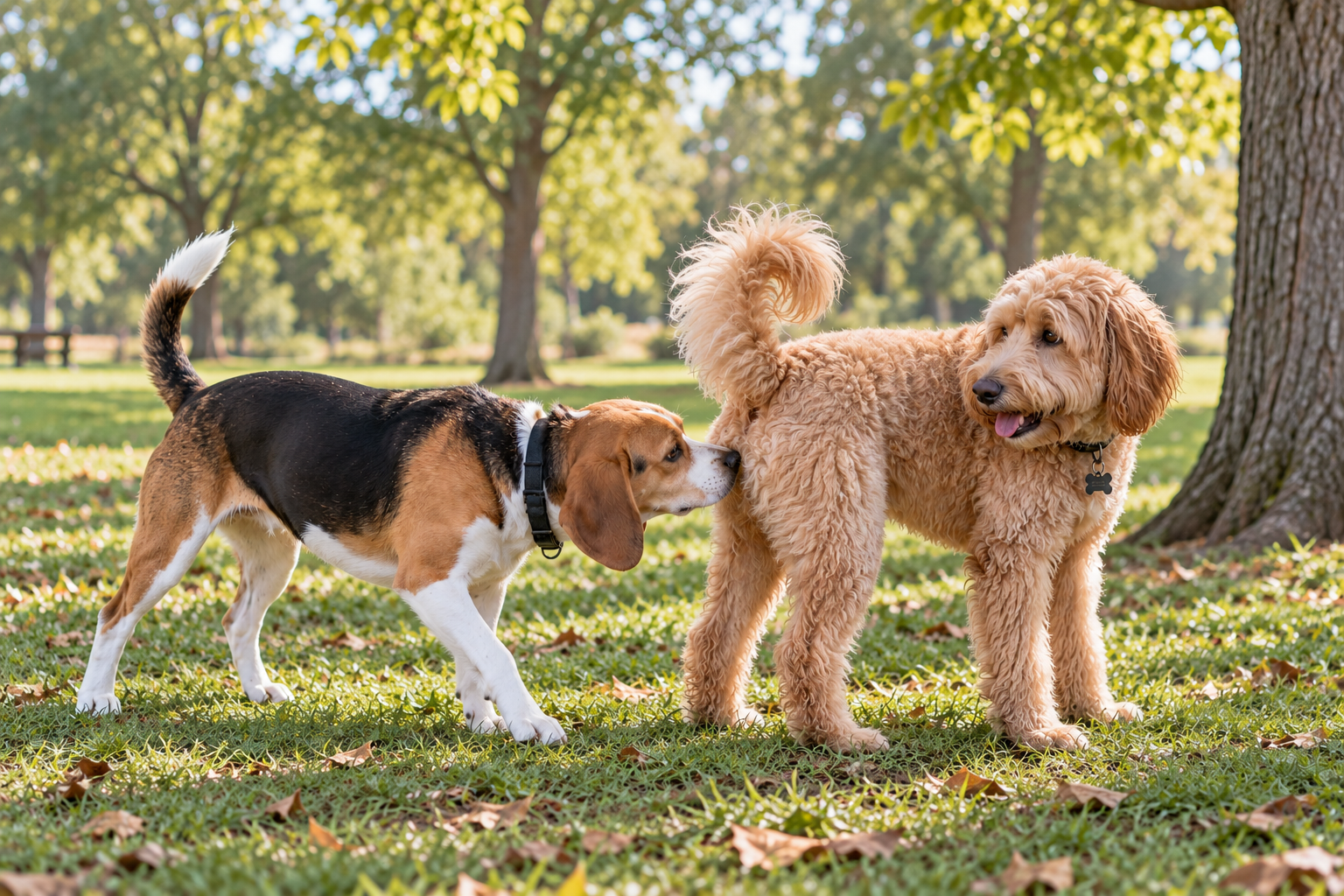
Research into canine anal-sac secretions from 17 dogs identified three related odorant-binding proteins. These proteins can bind volatile molecules. The researchers concluded that their presence supports an important role for anal-sac secretions in canine chemical communication.
A separate study of only ten dogs found differences between the volatile profiles of male and female anal-sac secretions. That result is intriguing, but larger studies need to confirm it. So the familiar rear-end greeting is not random bad manners. The perianal area is a rich source of scent information, and investigating it is normal canine social behavior.
We do not yet have a word-for-word translation of what one dog learns about another. We do, however, have a biological reason for all that enthusiastic sniffing.
Do Dogs Have a Special Organ for Detecting Pheromones?
Dogs have a vomeronasal organ, sometimes called Jacobson’s organ. This structure helps detect chemical signals in many animals. Its presence has encouraged a tidy explanation: ordinary odors go to the nose while pheromones go to a separate pheromone detector. Canine biology refuses to be quite that tidy.
The vomeronasal system is only part of the story. Veterinary research indicates that the main olfactory system can also detect chemical signals. It is therefore misleading to divide canine smell into two completely separate channels. The dog’s extraordinary nose remains central while scientists continue to study how these sensory pathways work together.
Do Mother Dogs Produce Calming Dog Pheromones?
This is where canine chemical communication meets a large commercial market. Collars, diffusers, and sprays sold as dog-appeasing pheromone products aim to imitate fatty-acid mixtures associated with secretions from a nursing mother’s mammary area. The idea is appealing. Reproduce a maternal chemical signal, and perhaps a dog will feel more secure during stressful situations.
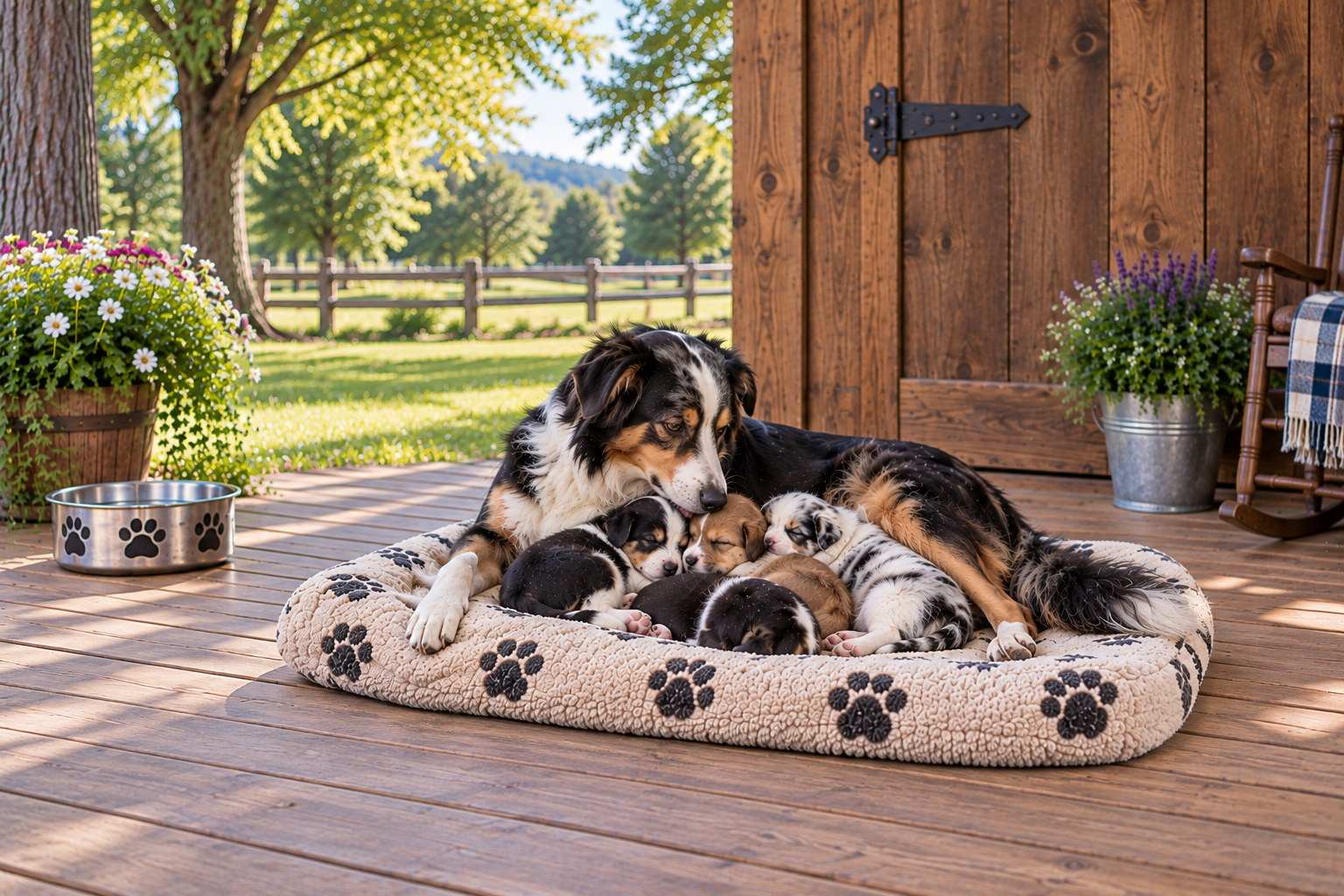
There is an important scientific wrinkle. A detailed review of canine semiochemicals found that dog-appeasing pheromone, commonly called DAP, has not been firmly demonstrated as a naturally functioning canine pheromone in the strict scientific sense. Dogs can perceive the compounds. Yet detecting an odor is not the same as proving that it is a pheromone.
That distinction separates two questions that people often blend together. Has DAP been proven to be a natural canine pheromone? The answer remains uncertain. Can a product containing these compounds affect a dog’s behavior? Researchers have tested that question, and the results are mixed.
Can Dog Pheromones Calm an Anxious Dog?
Possibly, depending on the dog and the situation. In one placebo-controlled study, researchers exposed 24 beagles to simulated thunderstorm sounds. Dogs wearing a DAP collar showed improvement in some measures of active and overall fear and anxiety. Dogs wearing placebo collars did not show the same pattern.
That is useful evidence, but the study was small. It also took place under controlled laboratory conditions and involved beagles without a history of noise phobia. Reviews of the wider research have found inconsistent results across different settings and behavior problems.
Thunderstorm fear, travel stress, adjustment to a new home, and separation anxiety are not interchangeable. All can involve stress, but each may have different causes and treatment needs. Products marketed as dog pheromones are therefore best viewed as possible supportive tools rather than stand-alone treatments.
Serious separation anxiety, destructive panic, extreme noise phobia, or another significant behavior problem deserves appropriate veterinary or behavioral evaluation. A collar, diffuser, or spray should not delay that care.
Delivery method may also affect how a product is used. A collar travels with the dog. A diffuser affects a particular area. A spray usually serves a more limited setting or event. The best choice depends on the product, the circumstances, and the evidence behind that use—not simply on the word “pheromone” on the label.
Are Pheromones the Reason Dogs Mark Their Territory?
Calling every urine mark “territorial” makes a complicated behavior sound deceptively simple. Dogs may investigate another dog’s urine and then place their own mark nearby or over it. However, marking can occur in several social and reproductive contexts. Sometimes “leaving a message” is a better mental picture than “claiming property.”
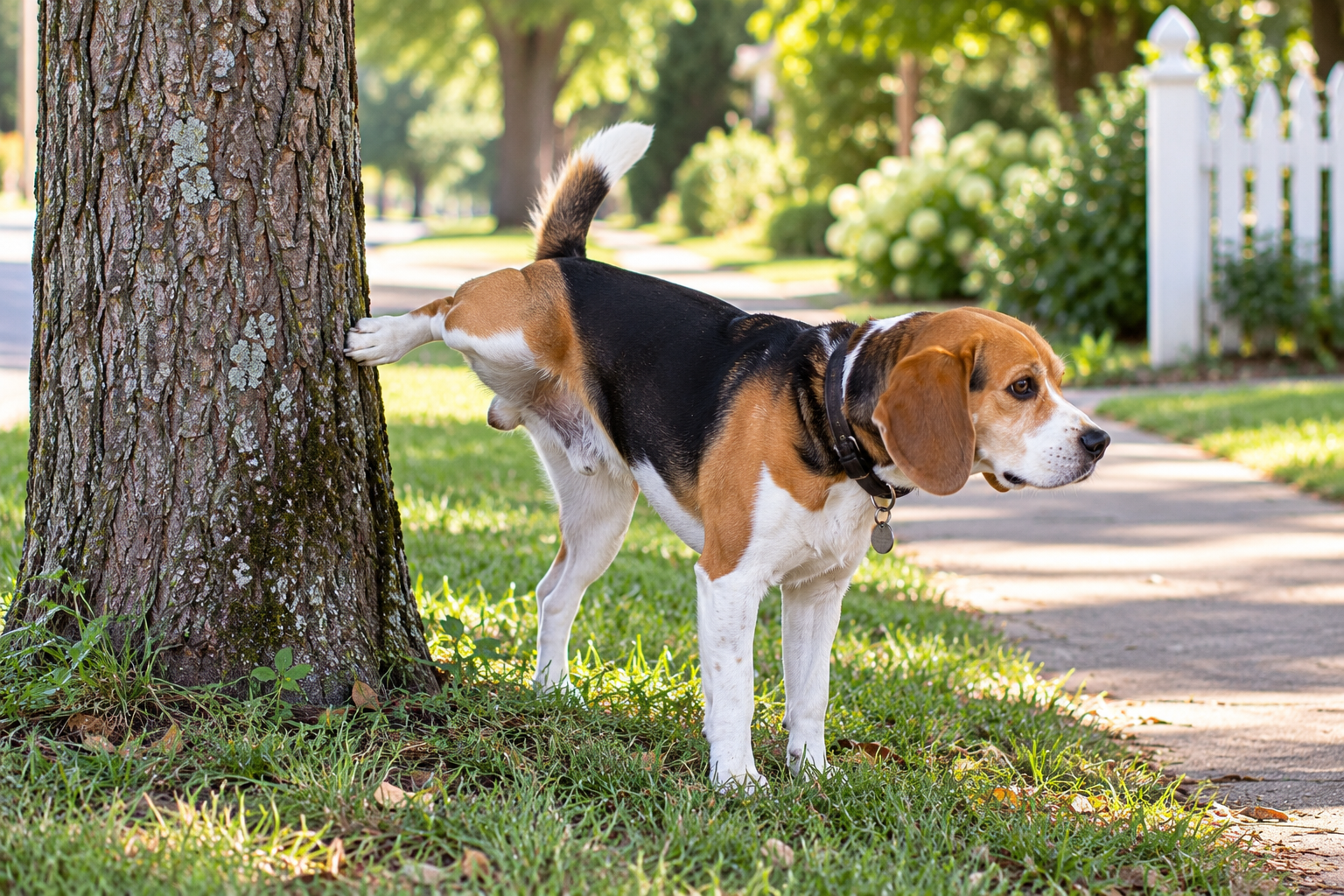
A recent study illustrates how much may be happening during this familiar behavior. Researchers exposed male dogs to urine odors from two unfamiliar dogs. One source was a female in estrus (in heat). The other was an intact male that displayed aggression toward other males.
The researchers examined marking behavior along with urinary hormones and neurotransmitters. They found preliminary relationships between the way dogs marked and physiological measures linked with arousal, social stress, and cognitive responses. The authors appropriately described the findings as preliminary.
The study does not provide a dictionary for translating individual urine marks. What it does show is why marking deserves more than the old “he’s claiming his territory” explanation. Smell, physiology, social context, and behavior may all participate in the exchange.
Do Dogs Use Scent and Pheromones to Recognize One Another?
Dogs clearly distinguish and respond to odors from other animals. Scent works alongside sight, sound, body language, and previous experience. Together, those channels give dogs access to information humans may overlook entirely. We tend to notice what another dog looks like. Our dogs may be far more interested in what that dog smells like.
The same broader sensory abilities help dogs evaluate people. Dogs observe human behavior while also detecting odors and other cues outside our conscious awareness. That provides useful context for research suggesting that dogs may respond differently to people based on the information available to them.
None of this requires imagining that a dog consciously translates every molecule into a fact. Chemical information is one part of a sophisticated sensory picture. That distinction lets us marvel at what dogs can do without giving them abilities the evidence has not demonstrated.
Chemical Communication Is Only Part of the Conversation
Dogs do not communicate by smell alone. They use body posture, facial expressions, movement, vocalizations, touch, and behavior. Those channels can work together. Chemical signals add another layer that humans often overlook because our own lives rely far less on smell.
Scent also has one feature that makes it very different from a growl, play bow, bark, or glance. It can remain after the animal has disappeared. Your dog can encounter traces of other dogs during an ordinary walk without ever seeing them.
A World Written in Scent
A tree or patch of grass may look completely unremarkable to you. To your dog, it may be one of the most information-rich stops on the route. The difference comes from a sensory world that humans experience only faintly.
The next time your dog becomes absorbed in sniffing what looks like absolutely nothing, consider what the two of you may be experiencing. You see the sidewalk, grass, trees, houses, and mailboxes. Your dog sees those things too, but also investigates an invisible chemical landscape left by animals that passed through before you arrived.
We have not decoded every message in that landscape. Some substances casually called dog pheromones may ultimately prove better described by another scientific term. Yet the larger discovery is already remarkable. Our dogs move through a world layered with chemical information, and every lingering sniff offers us a glimpse of how rich that world can be.
Veterinary Disclaimer: This article is for general educational purposes only and is not a substitute for professional veterinary advice, diagnosis, or treatment. Always consult your veterinarian about concerns involving your dog’s health or behavior.
Amazon Affiliate Disclosure: As an Amazon Associate, Excellent Dogs Club may earn from qualifying purchases. This does not change the price you pay.
Photo Credit: All images © Sloan Digital Publishing and licensed stock sources. Used with permission.