Scent work for dogs does not require a badge, a working title, or unusual talent. Every dog already relies on scent to understand the world. Scent work simply turns that natural ability into a structured activity.
That makes scent work practical for family dogs. You can start in a living room, hallway, backyard, or another familiar space. Most beginner games require little more than food, toys, boxes, and a few minutes.
Scent work also gives the dog an unusual amount of independence. You set up the problem, but the dog must solve it. Your job is usually to stand back, watch, and resist giving away the answer.
What Scent Work Actually Means
Scent work is any activity that asks a dog to locate something by smell. Formal scent sports use specific target odors and carefully designed searches. Home scent games can be much simpler.
A beginner might search for food hidden behind a chair or inside an open box. Another dog may search for a favorite toy or hidden family member. The important part is allowing the dog’s nose to guide the search.
Your dog does not need formal detection training to begin playing scent games. Everyday scent games can provide useful enrichment without becoming a competitive sport.
Why Dogs Enjoy Using Their Noses
Dogs experience much of their surroundings through scent. Searching gives them an opportunity to investigate, make choices, and solve a problem without constant direction from a person.
Scent work also fits naturally with the idea that dogs benefit from meaningful activities. Our article on why dogs need a job explains that concept in greater detail. Nose work is one practical way to provide that kind of purposeful activity.
The American Kennel Club describes scent work as an activity dogs of many breeds, sizes, and ages can enjoy. Formal competition is one option, but simple searching can begin at home with familiar objects.
What Research Actually Tells Us
Scent work is sometimes credited with an impressive list of benefits. While research offers some encouraging findings, it does not support every claim made about nose work. That is a good reason to describe its benefits carefully rather than to exaggerate them.
A 2019 study comparing nose work with heelwork found a more positive judgment bias after dogs practiced nose work. The researchers suggested that olfactory activity and greater opportunity for independent choices may contribute to canine welfare.
This more recent pilot study found associations between nose-work experience and some measures of executive function and persistence. However, the study involved a small number of dogs and does not prove that nose work causes broad cognitive improvements.
The sensible conclusion is modest. Searching allows dogs to use a natural behavior while solving a problem. We do not need to claim that it cures anxiety or replaces physical exercise to recognize its value.
Start With the Simplest Game: Find It
The easiest beginner game requires only a few small treats. Let your dog watch you place one treat several feet away. Then give a simple cue such as “find it.”
At first, make the answer obvious. After a few successful repetitions, many dogs begin to connect the cue with searching. Success should come easily during these first attempts.
Next, place the food beside a chair leg or partly behind an open object. Gradually move from visible placements to simple hidden ones. Try not to point repeatedly toward the answer while the dog is working.
Give your dog time to investigate, turn away, and try again. The search belongs to the dog once it begins.
Try a Beginner Box Search
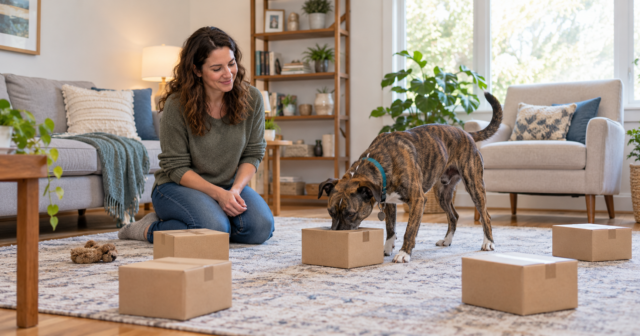
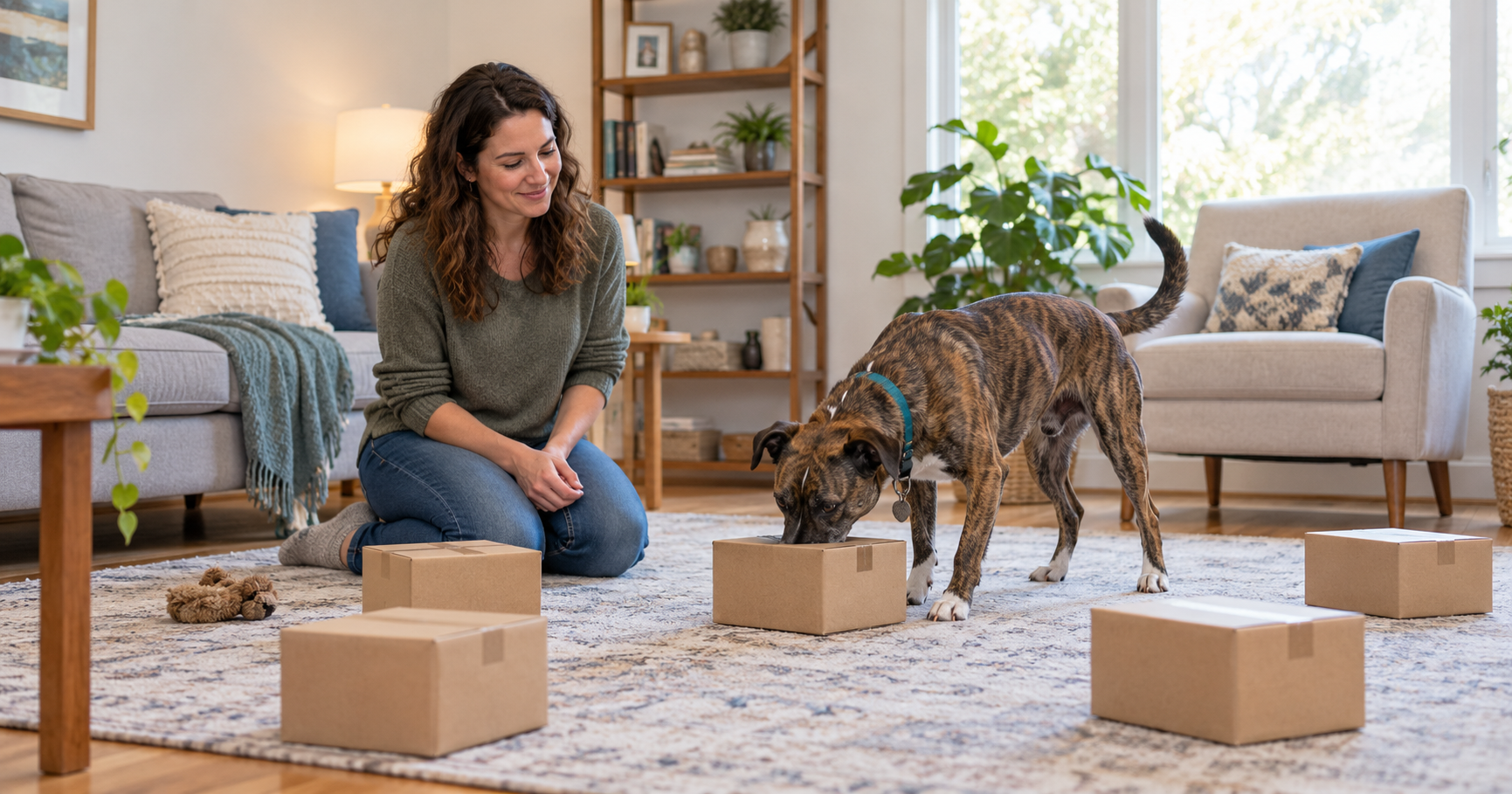
Cardboard boxes make excellent beginner scent-work equipment. Place two or three open boxes several feet apart and put a small treat inside only one. Allow your dog to investigate each box freely.
When the correct box is found, let the dog eat the reward. There is no need to require a sit, paw touch, or formal alert. The first goal is simply to let the dog learn that searching leads to success.
Watch what happens as the dog approaches the correct box. One dog may slow down, while another sniffs more rapidly or repeatedly returns to the same spot. These changes help you learn what your own dog looks like when something smells interesting.
As the game becomes familiar, increase the number of boxes or change their positions. Later, try the same game in another room. Keep the searches easy enough to succeed because the goal is persistence, not tricking the dog.
A Snuffle Mat Can Be an Easy Starting Point
A snuffle mat can offer another simple introduction to searching. Food scattered through folds of fabric gives the dog an easy way to use its nose without requiring a larger search area.
The dog must use the nose to locate individual pieces. This creates a simple food-searching activity without requiring a larger search space. For dogs completely new to nose games, a snuffle mat can be an easy starting point.
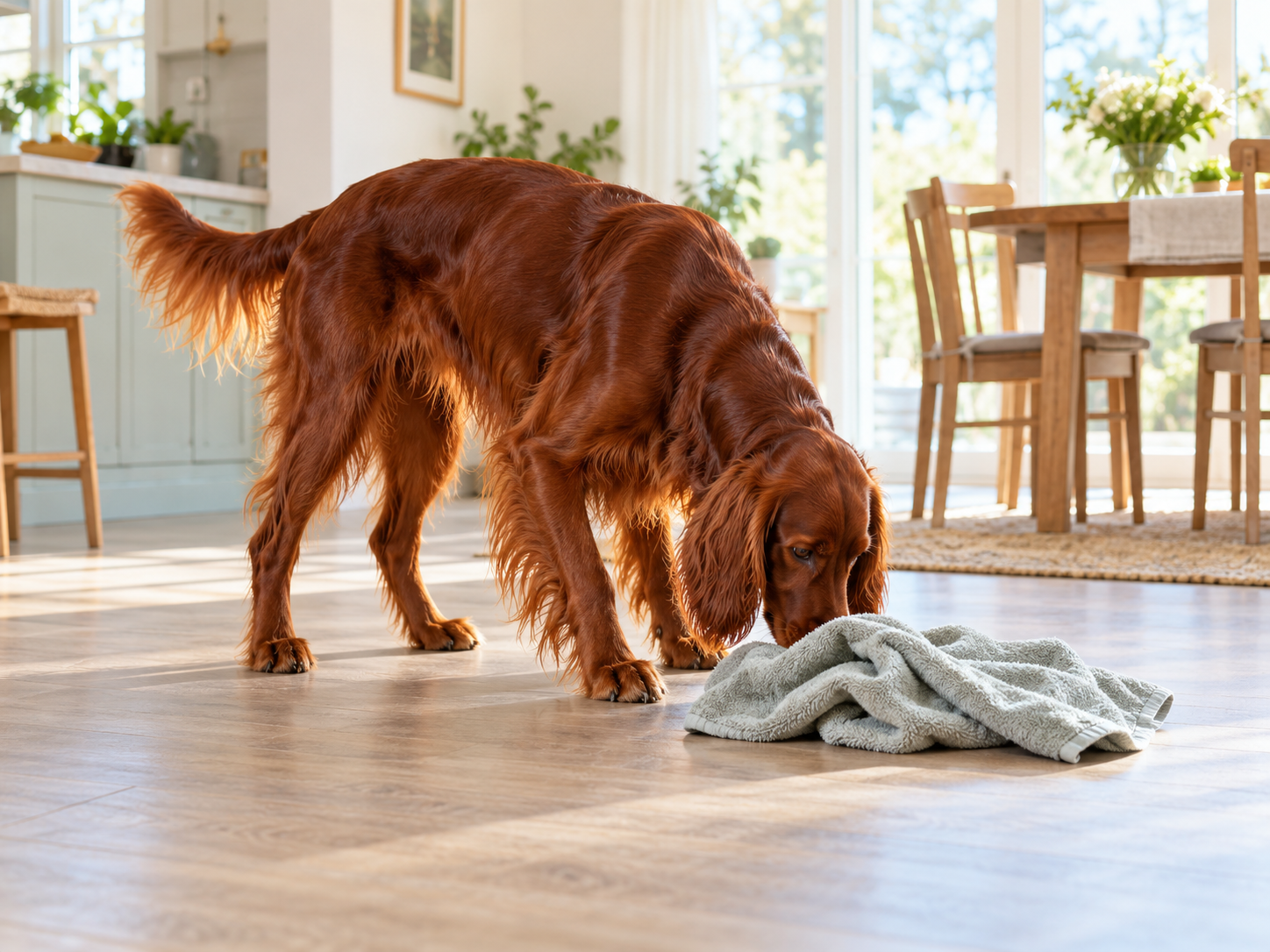
Supervise the activity, especially with dogs that chew or swallow fabric, and remove the mat when the food search ends. A snuffle mat is not the same as searching an entire room. Think of it as an introduction that can lead to more challenging games later.
Hide a Favorite Toy
Food is convenient, but not every search needs an edible reward. Some dogs care much more about a ball, tug toy, or another favorite object.
Begin by letting your dog watch you hide the toy nearby. Give your search cue, allow the dog to find it, and reward the discovery with play. Later, hide the toy while the dog waits elsewhere and begin with easy locations before making the search more difficult.
This version works especially well when extra treats are undesirable. The reward becomes finding the toy and getting to play with you.
Play Find the Person
A family member can become the target of another simple scent game. Have someone stay with the dog while another person hides nearby. Choose an obvious hiding place at first so the dog has a good chance of succeeding.
The hidden person can call once if the dog needs help, then reduce those clues as the game becomes familiar. When the person is found, make the discovery rewarding with praise, play, or a small treat.
This game also provides another chance to observe your dog’s searching style. Changes in speed, direction, head position, or sniffing may suggest that the dog is narrowing the search.
Take the Search Outside and Add Difficulty Slowly
Outdoor scent work creates an entirely different challenge. Wind can move odor away from its source, while grass, soil, wildlife, and neighboring animals provide competing smells.
A dog that searches confidently indoors may seem less certain outside. That does not mean the dog has forgotten the game. The scent problem has simply become more complicated.
Begin in a fenced yard or another quiet area. Use a leash or long line unless the space is securely enclosed, and never trade physical safety for a more difficult search.
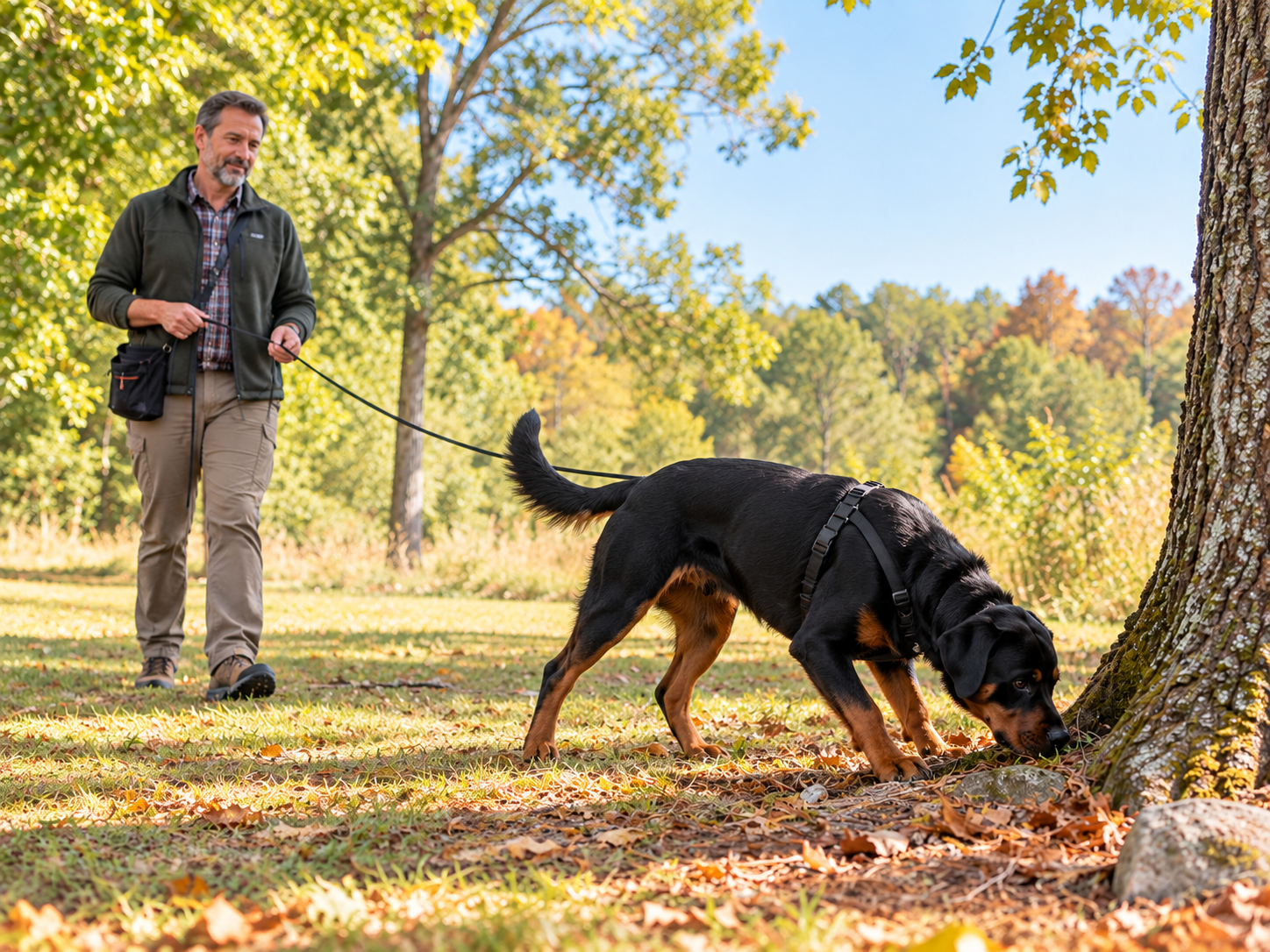
Increase only one challenge at a time. You might add distance during one session and use more hiding places during another. Height can also change the scent picture, but avoid locations requiring unsafe climbing or jumping.
Keep sessions fairly short, especially while the dog is learning. Ending after a successful search often preserves enthusiasm for the next game.
Common Beginner Mistakes
Helping too much is one of the easiest mistakes to make. People naturally want to point when a dog hesitates, but repeated help can turn a scent game into an exercise in following the human.
Advancing too quickly causes similar problems. Success with three boxes in the living room does not guarantee success with the same search in a windy yard. Repeating the cue continuously can also interfere with concentration, so give the cue and allow the dog time to work.
Long sessions are rarely necessary. A few successful searches may be enough, especially for a beginner. Stop while the dog is still interested instead of continuing until enthusiasm disappears.
Finally, avoid comparing dogs. One may search rapidly while another works slowly and methodically. Those differences do not automatically indicate greater or lesser ability.
If your dog enjoys problem-solving but scent searches are not a favorite, other brain games for dogs can provide different kinds of mental enrichment.
Adjust Scent Work to the Individual Dog
Senior dogs may enjoy scent games while needing easier physical setups. Keep searches on stable, nonslip surfaces and avoid unnecessary stairs or jumping. Dogs with significant mobility problems may need veterinary guidance before changing their activities.
Dogs with limited vision or hearing may also be able to enjoy scent games when the setup is appropriate for them. Remove obstacles that could cause collisions or falls, and keep the search area predictable while the dog learns the game.
An anxious dog may need especially familiar surroundings. Do not pressure a nervous dog into dark rooms, unfamiliar spaces, or situations that create obvious distress. The activity should invite exploration rather than force it.
Dogs with food allergies, weight concerns, or special diets may need different rewards. Part of the normal meal can often replace extra treats.
Why Beginners Do Not Need Essential Oils
Formal scent sports use specific target odors. In AKC Scent Work, dogs eventually search for prepared odors including birch, anise, clove, and cypress.
Those materials are part of an established training system. Owners who simply want enrichment at home do not need to begin with concentrated oils, scent preparation, or formal odor-handling procedures.
Food, toys, boxes, and familiar people provide plenty of useful beginner searches. Owners who later want to learn formal odor work can do so through an experienced instructor or established scent-work program.
When You Want to Go Beyond Everyday Scent Work
Some owners discover that both they and their dogs genuinely enjoy searching. At that point, a structured scent-work class may be worth considering.
Formal instruction can introduce target odors, search patterns, leash handling, and methods for recognizing a dog’s alert. It can also teach handlers how to avoid accidentally guiding the dog toward the answer.
Competition is optional. Many people simply enjoy learning more advanced search techniques with their dogs, while others remain perfectly happy with casual searches at home.
The Bottom Line
Your dog does not need special credentials to enjoy scent work. A few treats, cardboard boxes, a favorite toy, or a hiding family member can be enough to begin. Scent work for dogs can remain a casual activity at home or eventually develop into formal training.
Start with an easy problem and let the dog solve it. Increase the difficulty gradually while keeping the experience safe and enjoyable. Sometimes the simplest enrichment is giving a dog permission to stop following our directions for a few minutes and follow the nose instead.
Disclosure: This article may contain affiliate links. As an Amazon Associate, we earn from qualifying purchases. If you click and buy, we may earn a small commission at no extra cost to you.
Photo Credit: All images © Sloan Digital Publishing and licensed stock sources. Used with permission.