
Your dog drops beside you, stretches out, and releases a sigh so deep you would think he had spent the day cleaning the house, paying the bills, and worrying about the mortgage.
You look at him. He looks at you. And for just a moment, it is very tempting to believe you know exactly what he is thinking.
But why do dogs sigh? Is that dramatic exhale really an expression of contentment, disappointment, or frustration? Sometimes the circumstances give us useful clues. The mistake is assuming that a sigh has one fixed translation.
To understand it, don’t listen only to the sigh. Look at the dog attached to it.
Why Do Dogs Sigh?
A sigh is essentially a deeper breath followed by a noticeable exhale. Researchers studying canine behavior have recorded sighing as an observable behavior, but science has not given dog owners a simple dictionary in which one sigh means contentment and another means disappointment.
That is important because dogs make it remarkably easy for us to personify them. A long exhale after you refuse to share your sandwich can sound exactly like human exasperation. We naturally supply the dialogue: Fine. I didn’t want it anyway.
Your interpretation may even fit the situation. It just isn’t something we can prove from the sigh alone.
Instead, look at what happened immediately before the sigh and what the rest of your dog’s body is doing. Eyes, ears, mouth, muscles, movement, breathing, and posture can turn one dramatic sound into a much more informative picture.
The Sigh of a Dog Who Is Completely Content
This may be the sigh dog owners recognize most easily.
Your dog circles his bed, flops down, lowers his head, and releases one enormous breath. His muscles loosen. His eyes begin to droop, or close completely. Five minutes later, he is asleep.
In that setting, relaxation is a very reasonable interpretation. It isn’t the sound alone that tells you this. The entire sequence does.
Some dogs seem to save their finest sighs for the sofa beside their favorite person. Others choose a sunny patch on the floor, their own bed, or the coolest tile in the house. The location varies, but a loose body followed by peaceful rest gives the sigh useful context.
Dogs also have wonderfully individual sleeping habits. Our guide to why dogs sleep in such strange positions explores some of the peculiar ways dogs make themselves comfortable.
Is the “You Said No” Sigh Really Frustration?
Then there is the masterpiece.
You stop throwing the ball. Dinner has already been served. The back door did not open on demand. Or, in an astonishing lapse of judgment, you decide that your sandwich belongs to you.
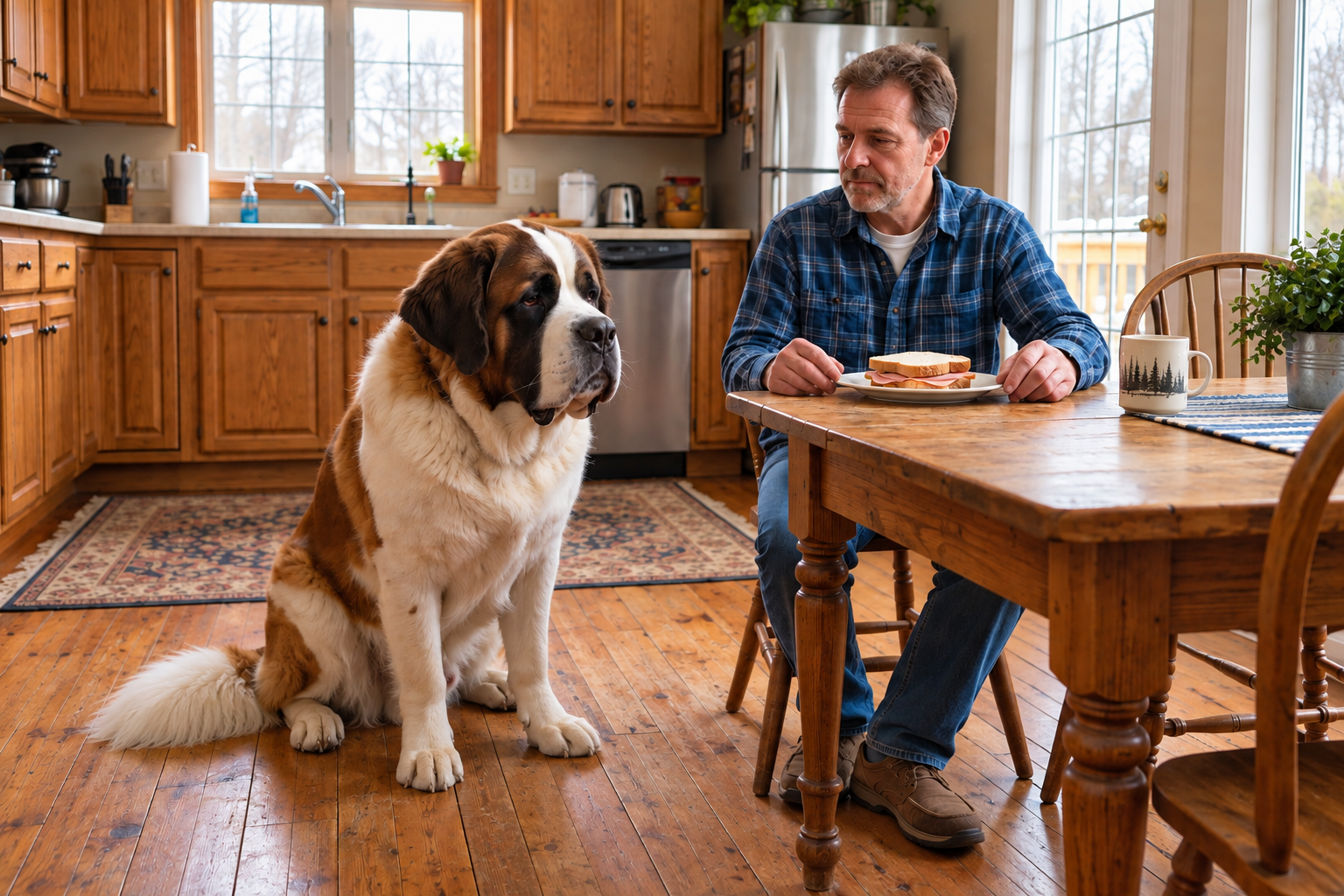
Your dog stares at you, drops to the floor, and sighs like a disappointed teenager.
Could frustration be part of the picture? Certainly. Dogs can experience frustration when something they want is unavailable. But once again, the surrounding behavior tells us more than the sound itself.
A dog who keeps staring at the desired object, paws at you, shifts position, returns to the door, or tries another behavior still appears motivated to achieve something. If he eventually sighs, settles down, and abandons the effort, the whole sequence is more informative than the exhale.
What we should resist is adding an elaborate human story. Your dog can be frustrated without thinking, After everything I’ve done for this family, she won’t even give me half a turkey sandwich.
Although his performance may strongly suggest otherwise.
Did You Accidentally Teach Your Dog to Sigh at You?
This possibility may be even more entertaining.
Dogs are excellent at discovering which behaviors make humans respond. They don’t need to sit down and devise a strategy. If a behavior repeatedly produces something worthwhile, that behavior has a reason to happen again.
Imagine that your dog sighs loudly beside you. You laugh, look at him, say, “Oh, what is wrong with you?” and scratch his ears.
From your perspective, you responded to a funny moment. From your dog’s perspective, something he did was followed by attention.
If the pattern repeats often enough, the sigh itself can become part of a learned interaction. The reward does not have to be food. Eye contact, conversation, petting, getting up from your chair, or opening a door can all be valuable to a dog.
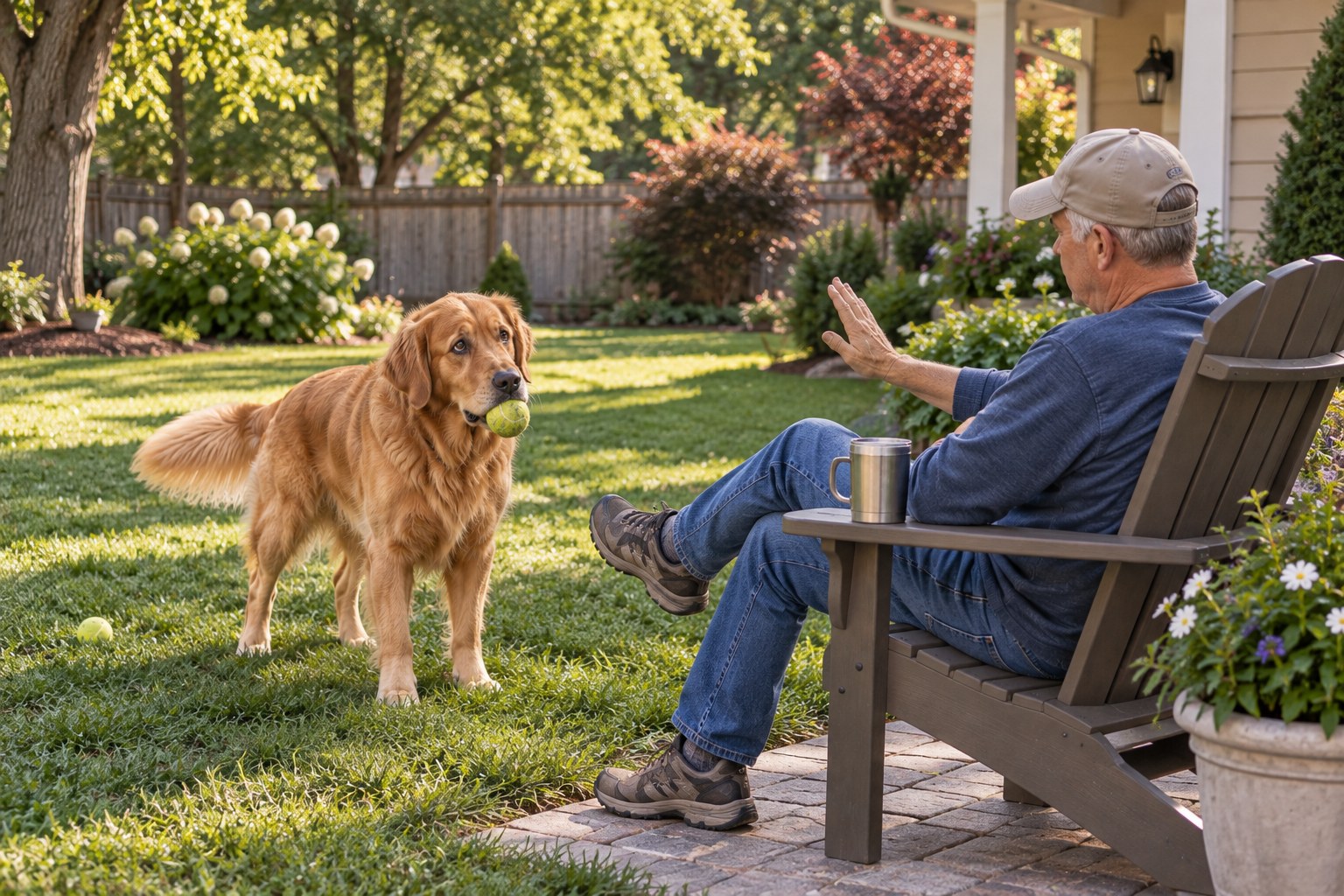
This does not mean your dog is calculating how to manipulate you. It means dogs learn from consequences—something every successful dog trainer already uses.
And humans are remarkably easy to train when the dog is charming enough.
Can Sighing Be a Sign of Stress?
It can occur in stressful situations, which is another reason a sigh should never be interpreted in isolation. Researchers observing dogs in behavioral studies have included sighing among the behaviors they record, including under potentially stressful conditions.

But a single sigh does not diagnose stress.
Look instead for a collection of signals. A dog experiencing stress or heightened arousal may pant, pace, repeatedly lick the lips or nose, hold the body lower or more tensely, tremble, vocalize, or have difficulty settling. Individual dogs vary, and some behaviors associated with stress can also occur in other situations.
The circumstances add another layer. A sigh from a loose, sleepy dog sprawled beside you on a quiet evening presents a very different picture from a sigh produced by a tense dog pacing during an unfamiliar or frightening experience.
The question becomes less “What does that sigh mean?” and more “What is my dog doing and experiencing right now?”
Why Does My Dog Sigh Before Going to Sleep?
This one usually requires less detective work.
A dog settles into a comfortable position. His body relaxes. His head drops. Then comes the long exhale before his eyes close.
When sighing appears as part of that familiar sequence, there is little reason to search for a complicated emotional explanation. The dog looks comfortable because the rest of his behavior looks comfortable.
That is also why learning your own dog’s normal patterns is so useful. One dog may sigh almost every night before falling asleep. Another may rarely make the sound. A familiar behavior occurring in its familiar setting is generally easier to interpret than a sudden change.
What If Your Dog Sighs While Looking at You?
This is where dogs make the game especially difficult.
A dog who looks directly at you and sighs practically begs for a human translation. Perhaps he wants attention, or, perhaps he was already relaxing. Maybe he has learned that this particular combination of eye contact and theatrical breathing gets an immediate response.
Look at what happens next.
Does he walk toward the door? Bring you a toy? Put a paw on your leg? Curl up and sleep? Continue staring until you finally surrender?
The behaviors surrounding the sigh may reveal what the dog wants much more clearly than the sigh itself.
Over time, families often learn these individual patterns. You may recognize your dog’s bedtime sigh, waiting-for-dinner sigh, or spectacularly aggrieved no-more-fetch sigh. That familiarity is useful as long as we remember that we are recognizing patterns rather than translating a canine word.
When a “Sigh” May Really Be a Breathing Problem
Most ordinary dog sighs are not medical emergencies. However, a repeated unusual breathing sound is different from the occasional dramatic exhale of an otherwise comfortable dog.
Pay attention to a change in breathing pattern, especially if it occurs with coughing, weakness, unusual fatigue, an increased breathing rate while resting or sleeping, or visible effort to breathe. Those signs deserve veterinary attention.
Veterinary guidance commonly places a normal resting or sleeping respiratory rate for dogs around 15 to 30 breaths per minute. A rate that is consistently above 30 while the dog is resting or sleeping should prompt a call to your veterinarian, particularly when it represents a change for that dog.
Obvious difficulty breathing is different. Labored breathing, major changes in breathing posture, collapse, or gray or blue mucous membranes can signal respiratory distress and require urgent veterinary care.
If you cannot tell whether your dog is sighing, wheezing, snorting, grunting, reverse sneezing, or making another respiratory sound, then record a short video when it happens. Showing your veterinarian what you are seeing and hearing would be far more useful than trying to reproduce the noise in the exam room.
Learn Your Own Dog’s Sighing Vocabulary
You probably know more about your dog’s patterns than you realize.
Think about when the sigh occurs. Notice what happened immediately beforehand. Then look at the eyes, ears, mouth, muscles, tail, posture, and activity that accompany it.
A soft dog melting into the sofa gives you one picture. A restless dog pacing near the door gives you another. A dog staring pointedly at your dinner plate may not require advanced behavioral training to interpret.
If you enjoy learning those subtler signals, Doggie Language by Lili Chin is an approachable illustrated guide to canine body language. Learning to notice the whole dog is far more useful than assigning a fixed meaning to one sound.
Sometimes a Dog Sigh Is Just a Sigh
Perhaps the most satisfying answer is also the least dramatic. Dogs sigh during ordinary life.
A sigh can accompany a dog settling comfortably to sleep. It may occur after something he wanted becomes unavailable. It can appear during stress, or it may become part of a learned interaction because humans keep rewarding an especially impressive performance.
What science does not give us is permission to translate every long exhale into a specific sentence.
So enjoy the dog who collapses beside you after his exhausting day of watching you work. Check the rest of his body before deciding what the performance means.
He may be comfortable, or he may be mildly frustrated. He may be hoping you finally notice that nobody has scratched his ears in nearly four minutes.
Or sometimes, a sigh really may be just a sigh.
Sources
- Taylor et al.: The Effect of Pet Remedy on the Behaviour of the Domestic Dog
- Frontiers in Psychology: Where Do We Stand in the Domestic Dog Positive-Emotion Assessment?
- Merck Veterinary Manual: Initial Triage and Resuscitation of Small Animal Emergency Patients
- VCA Animal Hospitals: Home Breathing Rate Evaluation
Veterinary Disclaimer: This article is for general educational purposes only and is not a substitute for professional veterinary advice, diagnosis, or treatment. Always consult your veterinarian about concerns involving your dog’s health or behavior.
Amazon Affiliate Disclosure: As an Amazon Associate, Excellent Dogs Club may earn from qualifying purchases. This does not change the price you pay.
Photo Credit: All images © Sloan Digital Publishing and licensed stock sources. Used with permission.